
Trucking Company Insurance That Won’t Break the Axle
Why Trucking Company Insurance Is the Backbone of Every Freight Operation
Trucking company insurance is a set of specialized coverages that protect your trucks, cargo, drivers, and business from the financial fallout of accidents, theft, lawsuits, and regulatory penalties.
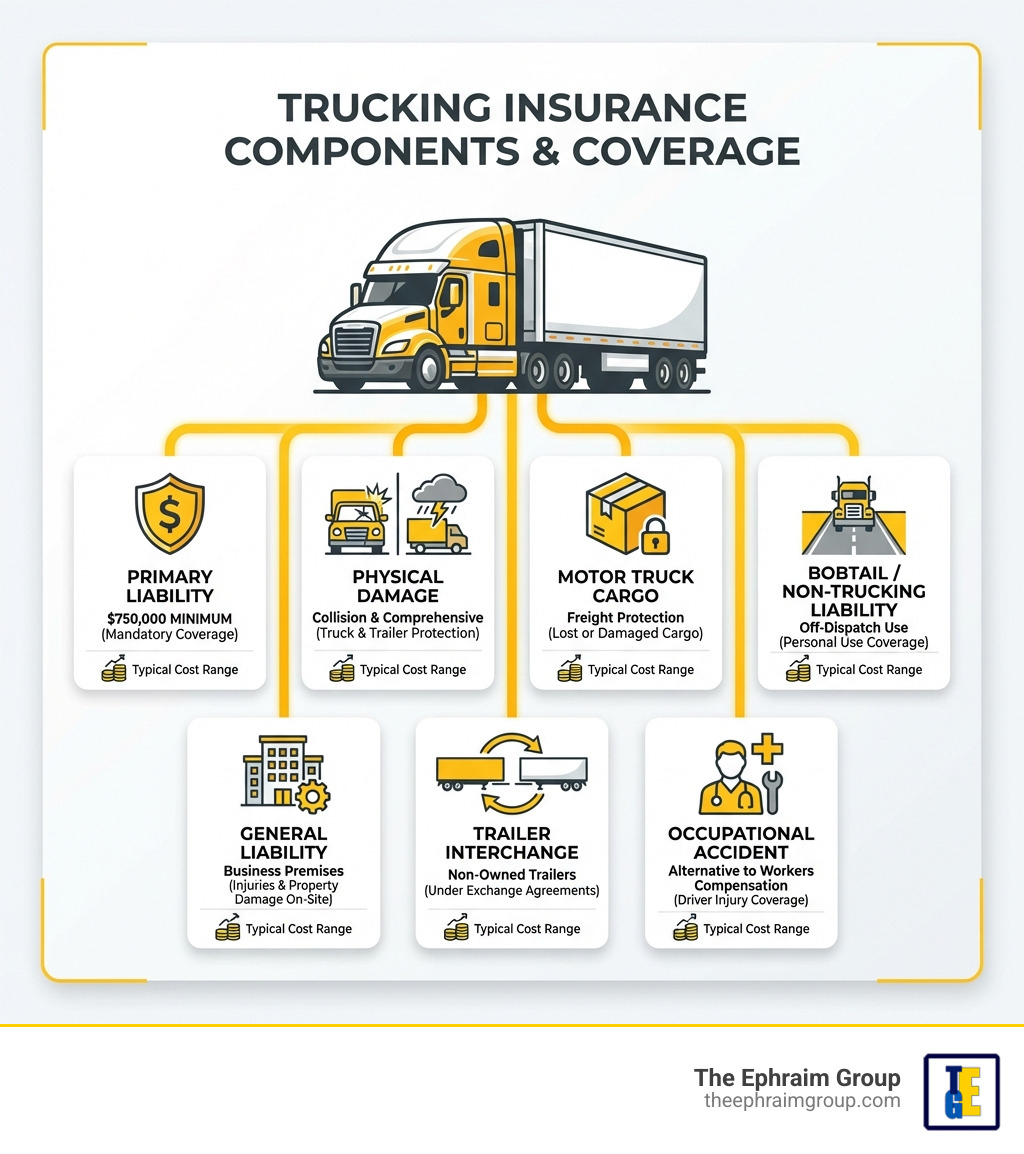
Here’s a quick look at the core coverage types most trucking businesses need:
| Coverage Type | What It Protects |
|---|---|
| Primary Liability | Injuries and property damage you cause to others |
| Physical Damage | Your truck (collision, theft, weather) |
| Motor Truck Cargo | Freight you’re hauling if lost or damaged |
| Bobtail / Non-Trucking Liability | Your truck when it’s off dispatch or running empty |
| General Liability | Injuries or damage at your business location |
| Trailer Interchange | Non-owned trailers under exchange agreements |
| Occupational Accident | Driver injuries when workers’ comp doesn’t apply |
Around 72% of the nation’s freight moves by truck each year. That’s a massive economic responsibility — and a massive risk. In 2022 alone, nearly 6,000 large trucks were involved in fatal crashes, and more than 120,000 caused injuries. Even the most skilled driver can’t control everything on the road.
Without the right coverage, a single accident can wipe out a small trucking operation entirely.
I’m Don M Walters, and through my work as an independent insurance professional with access to over 50 leading carriers, I’ve helped small business owners across Georgia find the right trucking company insurance without overpaying or underprotecting. Let’s break down exactly what you need — and why.
Essential trucking company insurance terms:
Understanding the Essentials of Trucking Company Insurance

When we talk about the trucking industry, we are talking about the literal engine of the American economy. Truckers collectively travel about 331 billion miles annually. With that much time on the road, the law of averages eventually catches up, even with the safest fleets. According to the National Safety Council’s crash statistics, fatal crashes involving large trucks rose 1.8% in 2022, representing a staggering 49% jump over the last decade.
This is why insurance for commercial trucks isn’t just a “nice-to-have” or a box to check for the DOT; it’s a vital shield for your livelihood. Commercial trucking insurance is highly customizable because every operation is different. A local dump truck operator in Lawrenceville has very different risks than a long-haul refrigerated carrier moving produce from Georgia to the West Coast.
The primary goal of any policy is risk mitigation. We want to ensure that if a driver swerves to miss a deer or a mechanical failure leads to a multi-car pileup, your company doesn’t go bankrupt paying for property damage, medical bills, or legal fees.
Minimum Liability for Your Trucking Company Insurance
The Federal Motor Carrier Safety Administration (FMCSA) doesn’t leave much to the imagination when it comes to how much coverage you must carry. These mandates are based on the weight of the vehicle and the type of cargo you are hauling.
| Vehicle Weight | Cargo Type | Minimum Liability Limit |
|---|---|---|
| Under 10,001 lbs | Non-hazardous | $300,000 |
| 10,001 lbs or more | Non-hazardous | $750,000 |
| Any weight | Oil / Non-classified Hazardous | $1,000,000 |
| Any weight | Hazardous Materials | $5,000,000 |
Most brokers and shippers won’t even look at your authority unless you have at least $1 million in trucking liability insurance. While $750,000 is the federal floor for large trucks, the industry standard has shifted higher to account for rising litigation costs.
Who Needs Specialized Coverage?
Not every policy is a one-size-fits-all “fleet” plan. Depending on your business structure, your needs will shift:
- Owner-Operators: If you have your own authority, you are responsible for the full suite of coverages. If you are leased to a motor carrier, they might provide your primary liability, but you’ll still need “buy-back” coverages like bobtail or physical damage.
- For-Hire Truckers: If you are being paid to move someone else’s property, you are a for-hire carrier and must meet the strictest FMCSA standards.
- Private Carriers: These are businesses (like construction or manufacturing firms) that haul their own goods in their own trucks. While they still need commercial truck fleet insurance, their cargo risks are often handled differently since they own the freight.
- Independent Contractors: These drivers often sit in a middle ground, needing coverage that satisfies both their motor carrier’s requirements and their own equipment lien-holders.
Federal and State Compliance: FMCSA and Georgia Mandates
Compliance is the name of the game in trucking. The Federal Motor Carrier Safety Administration (FMCSA) requirements are designed to ensure that every carrier has the “financial responsibility” to cover bodily injury, property damage, and even environmental restoration in the event of a hazardous spill.
If you are operating in Lawrenceville, Dacula, or Suwanee, you are subject to both these federal rules (if you cross state lines) and specific Georgia state mandates. Navigating commercial trucking insurance in Georgia requires an understanding of how these two layers of regulation overlap.
Critical Filings for Trucking Company Insurance
To prove to the government that you actually have the insurance you claim to have, your insurance provider must submit “filings.”
- BMC-91X: This is the most common federal filing. It’s a certificate sent to the FMCSA confirming you have the required public liability insurance.
- MCS-90: This is an endorsement attached to your policy. It ensures that the public is protected even if an accident isn’t technically “covered” by the policy terms (the insurance company pays the victim, then comes to you for reimbursement).
- Motus System: The FMCSA is currently modernizing its systems. By late 2025 and into 2026, the new Motus system will become the primary hub for Georgia truck insurance filings and interstate authority documentation.
Georgia State Minimums vs. Federal Rules
If you only operate within the state of Georgia (intrastate), you might think you can get away with lower limits. Georgia’s basic commercial auto minimums are $25,000 per person for bodily injury and $50,000 per accident. However, we almost never recommend these “bare minimums” for trucks.
Why? Because a 26,000-pound box truck moving through Grayson or Lawrenceville can cause significantly more than $50,000 in damage in the blink of an eye. Whether you are looking for commercial truck insurance in Georgia for a local delivery route or cheap commercial dump truck insurance in Georgia for a construction project, we always aim for limits that actually protect your assets, not just satisfy a clerk at the DMV.
Core Coverage Types for Every Fleet and Owner-Operator
Beyond the mandatory liability, a robust trucking company insurance policy includes several “physical” and “cargo” protections.
- Physical Damage: This is what pays to fix your truck. It includes Collision (hitting another vehicle or object) and Comprehensive (theft, fire, vandalism, or hitting a deer). For many owner-operators, their truck is their most valuable asset; semi-truck and trailer insurance ensures a total loss doesn’t end your career.
- Motor Truck Cargo: This covers the goods you are hauling. If you’re carrying $100,000 worth of electronics and the trailer flips, motor truck cargo pays the owner of those goods so you don’t have to.
- General Liability: This covers “slip and fall” incidents at your home office or terminal, as well as delivery errors (like dropping a load at the wrong warehouse, causing a financial loss for the client).
- Trailer Interchange: If you frequently haul trailers that you don’t own (common in “power-only” operations), this covers damage to those non-owned trailers while they are in your possession.
Specialized Trucking Company Insurance: Bobtail vs. Non-Trucking Liability
This is one of the most common points of confusion we hear in our Lawrenceville office. Let’s clear it up.
- Bobtail Insurance: This covers you when you are driving the truck without a trailer attached, regardless of whether you are “on the clock” or not. If you’ve dropped your load and are heading back to the yard empty, you need bobtail insurance.
- Non-Trucking Liability (NTL): This is specifically for personal use. If you take the tractor to the grocery store or a movie on your day off, NTL provides liability coverage. It typically does not apply if you are on dispatch or “deadheading” (driving an empty trailer) for business purposes.
Whether you’re looking for box truck insurance for local furniture delivery or long-haul coverage, knowing your dispatch status is key to choosing the right one.
Additional Protections to Consider
- Occupational Accident (Occ Acc): Many owner-operators in Georgia opt out of traditional workers’ comp. Occ Acc is a more affordable alternative that covers medical expenses and lost income if you are injured on the job.
- Roadside Assistance: Heavy-duty towing isn’t cheap. Specialized roadside coverage for trucks includes winching, jump-starts, and fuel delivery.
- Rental Reimbursement with Downtime: If your truck is in the shop for two weeks after a wreck, you aren’t making money. This coverage provides a daily stipend to help cover your fixed costs or the cost of a rental.
- Specialized Vehicle Coverage: If your business uses vocational vehicles, you might need commercial dump truck insurance which accounts for the specific risks of hydraulic lifts and off-road job sites.
How to Lower Your Premiums and Avoid Coverage Gaps
Let’s be honest: trucking company insurance is expensive. Average premiums for owner-operators with their own authority can range from $8,000 to $15,000 per year. However, there are several ways we help our clients find the cheapest commercial truck insurance in Georgia without cutting corners.
- Telematics and ELDs: Many insurers now offer significant discounts if you share your Electronic Logging Device (ELD) data. If your data shows safe braking, reasonable speeds, and consistent rest periods, your premium reflects that safety.
- Driver Experience: Hiring drivers with at least two years of clean CDL experience is the fastest way to lower your rates.
- Higher Deductibles: If you have the cash reserves to handle a $2,500 or $5,000 repair, raising your deductible can drastically lower your monthly premium.
- Bundling: We often suggest bundling your truck insurance with your general liability or a Business Owners Policy (BOP) to trigger multi-policy discounts.
- Safety Programs: Implementing a formal safety manual and regular driver training can make your “risk profile” much more attractive to underwriters.
Frequently Asked Questions about Trucking Insurance
How much does commercial trucking insurance cost on average?
The cost varies wildly based on your “radius of operation” and what you haul.
- Owner-operators with their own authority: $8,000 to $14,000 annually.
- Owner-operators leased to a carrier: $2,000 to $5,000 annually (since the carrier covers the primary liability).
- New authorities: Expect to pay on the higher end for the first three years until you have a proven safety track record.
What are common exclusions in trucking insurance policies?
Standard policies often exclude:
- Driver injuries: These are covered by Workers’ Comp or Occ Acc, not your auto liability.
- Intentional damage: If a driver intentionally wrecks a rig, the claim will be denied.
- Personal vehicles: Your truck policy won’t cover your personal Ford F-150 unless it’s specifically listed.
- Specific cargo: Certain items like jewelry, live animals, or explosives often require special “riders” and are excluded from standard cargo forms.
What is the difference between bobtail and trailer interchange insurance?
Think of it this way: Bobtail covers the truck when it has no trailer. Trailer Interchange covers the trailer when it’s someone else’s property. If you pick up a trailer at a rail yard that belongs to a shipping line, and you damage that trailer in a turn, Trailer Interchange is what saves your bacon.
Conclusion
At The Ephraim Group, we understand that your truck isn’t just a vehicle—it’s your office, your investment, and your family’s future. As an independent agency located in Lawrenceville, GA, we don’t work for one big insurance corporation; we work for you.
We specialize in providing personalized, customized care for truckers in Buford, Duluth, Suwanee, and Dacula. Whether you are a one-man show with a single box truck or a growing fleet manager, we have the expertise to close your insurance gaps and find competitive pricing that keeps your wheels turning.
Don’t let a gap in your coverage break your axle. Get a quote for small business insurance today and let us do the heavy lifting for your insurance needs.